
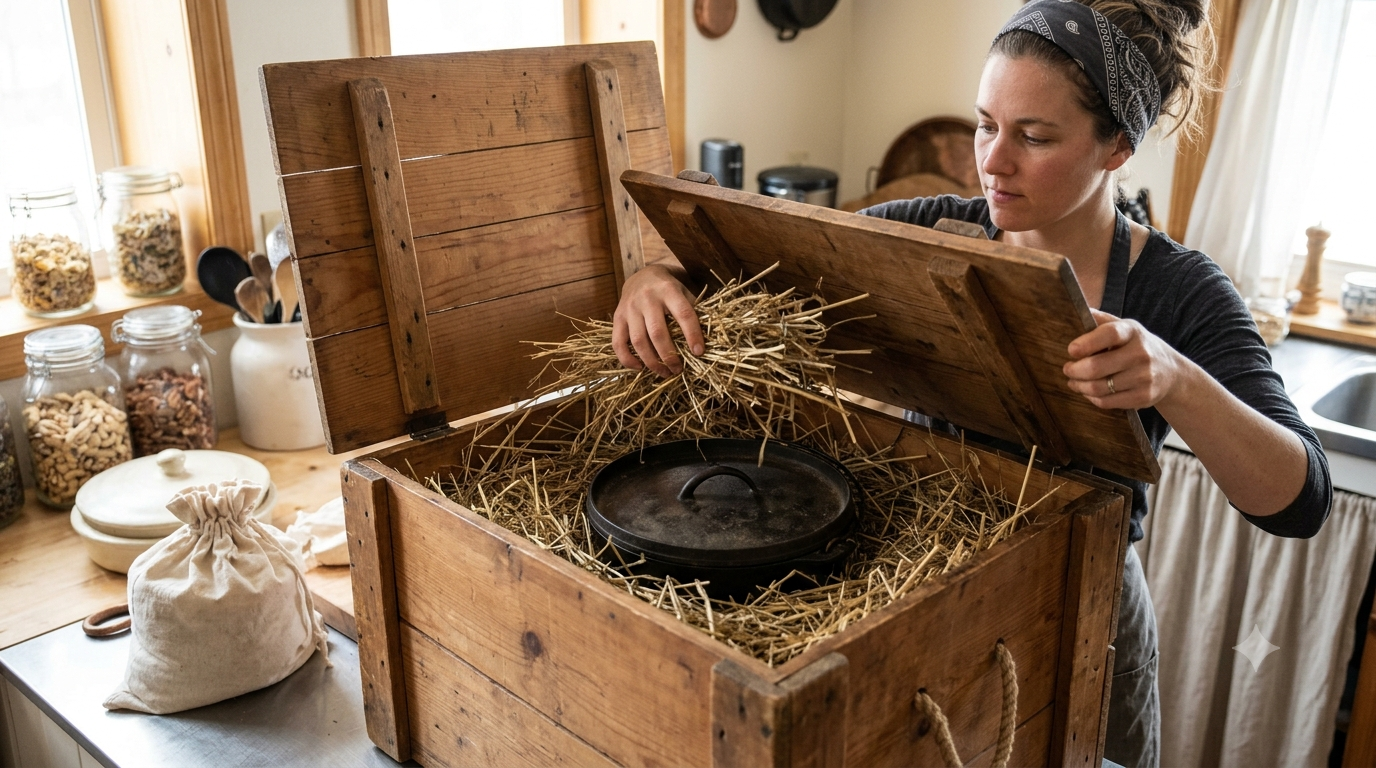
I felt the need for Haybox Cooking when conserving firewood and gas became essential during outdoor camping and off-grid cooking. Cooking for hours in hilly or open areas with strong winds and limited fuel was quite difficult, and keeping the fire lit continuously wasted both effort and fuel. In such a situation, Haybox Cooking proved to be an ideal solution, as it allows food to cook slowly in its own retained heat without requiring any extra gas or firewood, while keeping it hot for hours. When I tried Haybox Cooking for the first time, the biggest challenge I faced was temperature loss; due to using a lightweight pot and leaving air gaps inside the box, the heat escaped, leaving the food half-cooked. To resolve this issue, I replaced the aluminum pan with a heavy cast-iron pot that retains heat much longer and created a tight layer of grass and a woolen blanket inside the box to trap the heat. After making these small adjustments, I gave it another try, and within 3 hours, I got perfectly cooked, piping-hot food without using any extra fuel!
What is Haybox Cooking?
Haybox Cooking (also known as Thermal Cooking, Insulated Cooking, or Heat Retention Cooking) is an ancient, energy-saving cooking method where food is brought to a boil on a fire or stove for a short time and then placed inside an insulated box (called a haybox) so that it continues to cook slowly using its own retained heat.
How Does It Work?
-
Boiling: First, the food (such as lentils, rice, stews, or soup) is brought to a full, rolling boil in a pot over a stove or open fire until it is thoroughly heated through.
-
Placing in Insulation: The hot pot is then removed from the stove and placed inside a box or container. This box is packed with insulation like hay, old clothes, wool, or styrofoam, which prevents the heat from escaping.
-
Slow Cooking: The pot’s internal heat remains trapped inside, allowing the food to cook on its own slowly over the next 2 to 4 hours without requiring any gas, firewood, or electricity.
Benefits of Haybox Cooking:
-
Fuel Savings: Saves up to 70% on gas, electricity, or firewood because the majority of the cooking process requires no fuel.
-
No Risk of Burning: Since it is not over active heat, the food will never scorch or burn at the bottom.
-
Preserves Nutrients: The low-and-slow cooking method prevents vitamins and minerals from breaking down, resulting in better flavor extraction.
-
Ideal for Off-Grid Living and Emergencies: It is a budget-friendly and efficient technique for power outages, camping, or off-grid outdoor cooking.
In simple terms, it is a traditional, flame-free thermal cooker!