
The question I hear most from friends who are new to baking meat is not “what masala should I use?” It is “how long do I keep it in the oven?” I know that fear well. For a long time my baked chicken either came out golden outside and pink near the bone, or cooked through but dry as paper. Most recipes online are written for American ovens in Fahrenheit, and a few degrees or minutes can make a big difference.
What finally fixed it for me was not a magic recipe but two simple habits: always preheating the oven properly, and checking the inside with a cheap food thermometer instead of guessing from the colour outside. Over the years I wrote separate small posts for chicken, meatloaf, lasagna, sausages and brisket. This guide brings all of those times together in one clear chart, with Celsius first, so you can open it on your phone and cook with confidence.
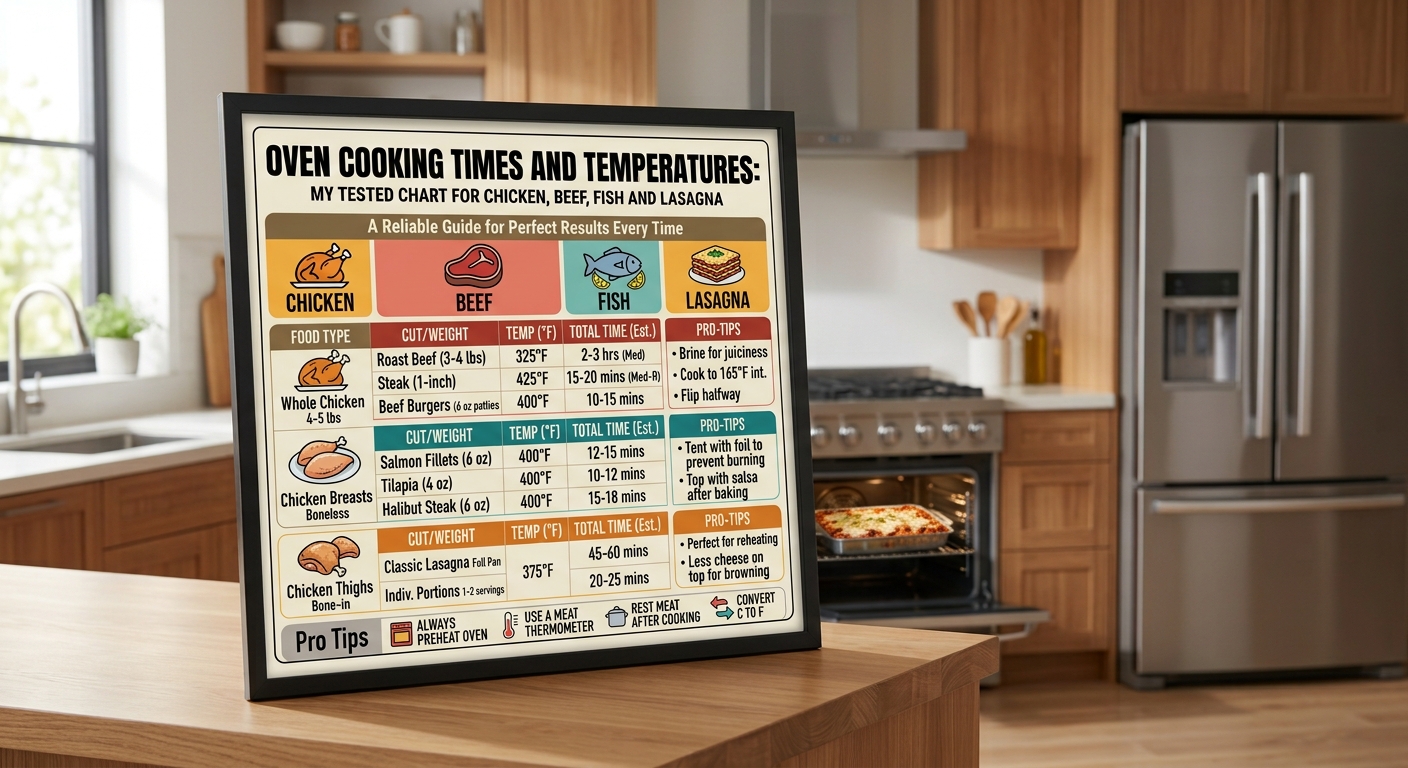
How to use this chart: times are for a preheated conventional oven with the tray on the middle rack. If you use a fan (convection) oven, lower the temperature by about 15°C or check 5 to 10 minutes earlier. Size and thickness always matter more than the clock, so check the internal temperature.
Safe Internal Temperatures (Most Important Chart)
| Food | Safe internal temperature | How it looks |
|---|---|---|
| Chicken and turkey (all cuts, mince, sausages) | 74°C (165°F) | Juices run clear, no pink near the bone |
| Beef or mutton mince, kababs, meatloaf, burgers | 71°C (160°F) | No pink in the centre |
| Beef or mutton steaks and roasts | 63°C (145°F) + 3 minutes rest | Well done: 71°C (160°F) and above |
| Fish | 63°C (145°F) | Opaque, flakes easily with a fork |
| Leftovers, lasagna, baked pasta, casseroles | 74°C (165°F) | Bubbling in the centre |
Push the thermometer into the thickest part of the meat, away from the bone.
Chicken Oven Cooking Times
| Cut | Oven temperature | Time |
|---|---|---|
| Boneless chicken breast (about 200 g) | 200°C (400°F) | 20–25 min |
| Boneless tikka pieces / cubes | 220°C (425°F) | 15–20 min |
| Bone-in thighs and drumsticks | 200°C (400°F) | 35–45 min |
| Chicken leg quarters (tandoori or Bukhari style) | 200°C (400°F) | 40–50 min |
| Chicken wings | 200°C (400°F) | 35–40 min |
| Whole chicken (about 1.5 kg) | 190°C (375°F) | 75–90 min |
My tip for juicy baked chicken breast: the outside browns fast while the inside is still raw. Flatten thick breasts to an even thickness, brush with oil, and rest them for 5 minutes after baking. They keep cooking slightly and stay juicy.
How Long to Bake Chicken at 400°F (200°C)
400°F is the temperature most American recipes use for chicken, and it is also my favourite. It is hot enough to brown the outside and crisp the skin, but not so hot that the inside dries out before it is cooked. Here are the times I use at 400°F:
| Chicken cut | Time at 400°F (200°C) |
|---|---|
| Boneless chicken breast (6–8 oz / 170–225 g) | 20–25 minutes |
| Thin-sliced breast or cutlets | 12–15 minutes |
| Chicken tenders (fresh) | 12–15 minutes |
| Boneless thighs | 20–25 minutes |
| Bone-in thighs or drumsticks | 35–45 minutes |
| Bone-in split breast | 35–45 minutes |
| Chicken wings (flip halfway) | 35–40 minutes |
| Leg quarters | 40–50 minutes |
| Whole chicken (3.5–4 lb / 1.6–1.8 kg) | 60–75 minutes |
How I bake chicken breast at 400°F:
- Preheat the oven to 400°F (200°C) with the rack in the middle.
- Pat the chicken dry. If one end is much thicker, flatten it gently so it cooks evenly.
- Rub with a little oil, salt, pepper and your spices, and place the pieces on a lined tray with space between them.
- Bake for 20 to 25 minutes, until the thickest part reaches 165°F (74°C) on a thermometer.
- Rest for 5 minutes before slicing so the juices stay inside.
400°F or 350°F? At 350°F (180°C), chicken breast takes about 25 to 30 minutes and browns less. I prefer 400°F because the shorter cooking time keeps the meat juicier. Frozen chicken breasts need about 50 percent longer; see my frozen foods guide for details.
Beef and Mutton Oven Cooking Times
| Dish | Oven temperature | Time |
|---|---|---|
| Meatloaf (900 g, loaf tin) | 180°C (350°F) / 200°C (400°F) | 55–65 min / 45–55 min |
| Seekh kababs or kofta on a tray | 220°C (430°F) | 15–18 min, turn once |
| Beef ribs (covered, then uncovered) | 160°C (325°F), then 200°C | 2 hr 30 min, then 15 min |
| Beef brisket, low and slow | 150°C (300°F) | about 2 hr 30 min per kg |
| Mutton raan (2 kg leg, covered) | 160°C (325°F) | 3 hr – 3 hr 30 min |
For meatloaf: add a ketchup or chilli glaze in the last 10 to 15 minutes, and let it rest 10 minutes before slicing so it does not crumble.
For brisket and raan: tough cuts need low heat and time, not high heat. Cover tightly with foil for most of the cooking so the meat does not dry out, then uncover at the end to brown the outside. The meat is ready when a fork slides in easily.
Fish Oven Cooking Times
| Fish | Oven temperature | Time |
|---|---|---|
| Thin fillets (thawed) | 200°C (400°F) | 12–15 min |
| Thick fillets or fish tikka | 200°C (400°F) | 15–20 min |
| Whole fish (about 1 kg) | 200°C (400°F) | 25–30 min |
Cooking fish straight from the freezer? See my how to cook frozen foods guide.
Lasagna, Baked Pasta and Ravioli
- Lasagna: 190°C (375°F). Bake covered with foil for 25 minutes so the centre heats through without drying the top, then uncover for 15 to 20 minutes until the cheese is golden and bubbling. Rest for 15 minutes before cutting so the layers hold.
- Baked pasta: 190°C (375°F) for 20 to 25 minutes, until bubbling.
- Fresh ravioli: boil for 3 to 5 minutes. Floating is not enough for meat-filled ravioli: the filling must reach 74°C (165°F). Homemade meat ravioli usually needs 1 to 2 minutes after floating.
- Frozen ravioli: boil for 6 to 8 minutes, or bake in sauce at 190°C for 25 to 30 minutes.
Sausages
- Oven: 200°C (400°F) for 20 to 25 minutes, turning halfway.
- Pan: medium heat for 12 to 15 minutes, turning often. High heat burns the casing before the centre is cooked.
- Chicken sausages must reach 74°C (165°F) and beef sausages 71°C (160°F).
Boiling Chicken: Times for Yakhni and Shredded Chicken
| Chicken | Simmering time |
|---|---|
| Boneless breast | 12–15 min |
| Bone-in thighs and drumsticks | 25–30 min |
| Curry-cut pieces for yakhni | 30–35 min |
| Whole chicken | 60–75 min |
Keep the water at a gentle simmer, not a hard boil, so the chicken stays tender. For shredded chicken, let the pieces cool in the stock for 10 minutes before pulling them apart.
My Oven Rules That Changed Everything
- Always preheat. Putting meat into a cold oven adds unpredictable time and dries it out.
- Buy a food thermometer. It costs less than one ruined dinner and removes all the guessing.
- Know your oven. Many home ovens in Pakistan run hotter or cooler than the dial. An oven thermometer shows the real temperature.
- Do not crowd the tray. Leave space between pieces so they roast instead of steaming.
- Rest the meat. 5 minutes for chicken pieces, 10 to 15 minutes for roasts, meatloaf and lasagna.
Quick Answers to Common Questions
How long does chicken take to bake at 200°C (400°F)?
Boneless breasts take 20 to 25 minutes, bone-in thighs and drumsticks 35 to 45 minutes. Always check for 74°C (165°F) inside.
Is 180°C the same as 350°F?
Yes, 180°C is the usual conversion for 350°F, and 200°C for 400°F. My kitchen measurement conversions guide has a full oven temperature table.
Can I cook chicken at a low temperature for longer?
For food safety, do not roast chicken or turkey below 160°C (325°F). Very low oven temperatures keep meat too long in the unsafe range.
Why is my baked chicken dry?
Usually because it was cooked too long. Take it out as soon as it reaches 74°C inside, and rest it before cutting.
Should I cover meat with foil in the oven?
Cover tough cuts like brisket and raan for most of the cooking, and lasagna for the first half. Leave chicken pieces uncovered so the skin can brown.
For a smoky BBQ finish on your oven-cooked meat, try the coal smoke method from my chicken seekh kabab, or see my beef tikka boti.

