This post contains affiliate links. As an Amazon Associate I earn from qualifying purchases, at no extra cost to you.
My Nani never owned a measuring cup. She cooked with “aankhon ka andaza”, a handful of this and a pinch of that, and somehow her food tasted the same every single time. I grew up trusting that andaza too, but the day I started writing recipes for this blog, I learned that my readers cannot see my hands.
Today people cook from oilyfloury.com in Pakistan, in the US and in many other places. A recipe written in cups confuses a reader who uses a kitchen scale, and a recipe written in grams confuses someone who only has cups and spoons. Over the years I wrote many small posts answering one question at a time: how many tablespoons are in 3/4 cup, how many cups are in a liter, what is 6 oz in cups. This page brings all of those answers together in one place, with simple charts you can save on your phone and use while you cook.
Quick note: all cup and spoon conversions below use standard US measurements (1 cup = about 240 ml). Many measuring cups sold in Pakistan are 250 ml. For everyday cooking the difference does not matter, but for cakes and cookies, check which cup you are using.
Cups to Tablespoons, Teaspoons and ml
This is the chart I use the most, especially when my measuring cups are dirty or missing and I only have spoons.
| Cup | Tablespoons | Teaspoons | Fluid oz | ml (approx.) |
|---|---|---|---|---|
| 1 cup | 16 tbsp | 48 tsp | 8 fl oz | 240 ml |
| 3/4 cup | 12 tbsp | 36 tsp | 6 fl oz | 180 ml |
| 2/3 cup | 10 tbsp + 2 tsp | 32 tsp | 5.3 fl oz | 160 ml |
| 1/2 cup | 8 tbsp | 24 tsp | 4 fl oz | 120 ml |
| 1/3 cup | 5 tbsp + 1 tsp | 16 tsp | 2.7 fl oz | 80 ml |
| 1/4 cup | 4 tbsp | 12 tsp | 2 fl oz | 60 ml |
| 1/8 cup | 2 tbsp | 6 tsp | 1 fl oz | 30 ml |
| 1 tablespoon | 1 tbsp | 3 tsp | 0.5 fl oz | 15 ml |
| 1 teaspoon | 1/3 tbsp | 1 tsp | 0.17 fl oz | 5 ml |
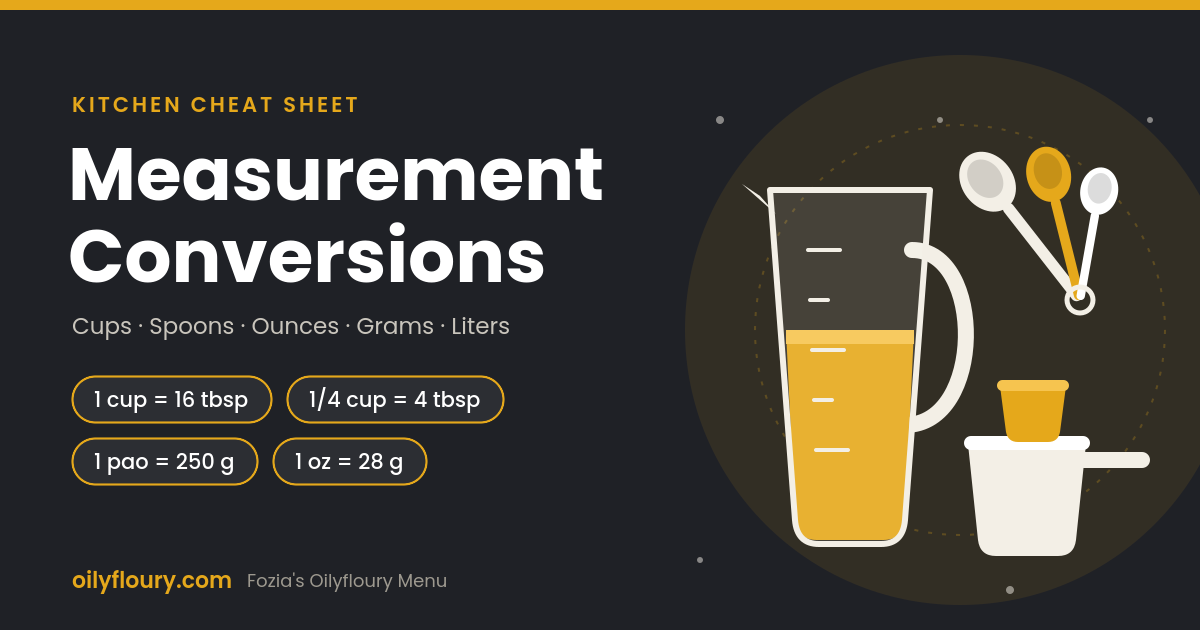
The one rule to remember: 1 tablespoon = 3 teaspoons, and 1/4 cup = 4 tablespoons. With these two numbers you can work out almost everything else in your head.
Liquid Measurements: Pints, Quarts, Gallons and Liters
For soups, drinks, yakhni and big dawat pots, these bigger measurements come up all the time.
| Measurement | Cups | Fluid oz | Liters / ml |
|---|---|---|---|
| 1 pint (US) | 2 cups | 16 fl oz | 473 ml |
| 1 quart | 4 cups | 32 fl oz | 946 ml |
| 1/2 gallon | 8 cups | 64 fl oz | 1.9 liters |
| 3/4 gallon | 12 cups | 96 fl oz | 2.8 liters |
| 1 gallon | 16 cups | 128 fl oz | 3.8 liters |
| 1 liter | about 4 1/4 cups | 33.8 fl oz | 1000 ml |
Pints in a liter: 1 liter is about 2.1 US pints. If your recipe is British, a UK pint is bigger (568 ml), so 1 liter is about 1.75 UK pints.
Ounces: Fluid Ounces vs Weight Ounces
This is where most kitchen mistakes happen. “Ounce” can mean two different things:
- Fluid ounces (fl oz) measure volume, for liquids like water, milk and oil. 8 fl oz = 1 cup.
- Ounces (oz) measure weight, for things like flour, sugar, butter and meat. You need a scale for these.
For water and milk, the two are almost the same, so 6 oz of milk is about 3/4 cup. But 6 oz of flour is not 3/4 cup. It is closer to 1 1/2 cups, because flour is light and fluffy. When a recipe says oz for a dry ingredient, weigh it.
Weight conversions (ounces and pounds to grams)
| Ounces / pounds | Grams (approx.) |
|---|---|
| 1 oz | 28 g |
| 3 oz | 85 g |
| 4 oz (1/4 lb) | 113 g |
| 6 oz | 170 g |
| 8 oz (1/2 lb) | 227 g |
| 12 oz (3/4 lb) | 340 g |
| 16 oz (1 lb) | 454 g |
| 2.2 lb | 1 kg |
Desi weights we use in Pakistan
| Desi measure | Grams | Pounds (approx.) |
|---|---|---|
| 1 kilo | 1000 g | 2.2 lb |
| Aadha kilo | 500 g | 1.1 lb |
| 1 pao | 250 g | just over 1/2 lb |
| Aadha pao | 125 g | about 1/4 lb |
Common Ingredients: 1 Cup in Grams
One cup of flour and one cup of sugar do not weigh the same. When I convert a recipe for baking, I use this chart. For flour, spoon it into the cup and level the top instead of scooping directly from the bag, otherwise you pack in extra flour and the cake turns dry.
| Ingredient | 1 cup | 1/2 cup | 1 tbsp |
|---|---|---|---|
| All-purpose flour (maida) | 125 g | 63 g | 8 g |
| Whole wheat flour (atta) | 120 g | 60 g | 8 g |
| White sugar | 200 g | 100 g | 12 g |
| Brown sugar (packed) | 220 g | 110 g | 14 g |
| Icing sugar | 120 g | 60 g | 8 g |
| Butter | 227 g | 113 g | 14 g |
| Oil | 218 g | 109 g | 14 g |
| Milk | 245 g | 123 g | 15 g |
| Uncooked rice | 190 g | 95 g | 12 g |
| Yogurt (dahi) | 245 g | 123 g | 15 g |
If you bake with different flours, my guides to edible flours explain how each one behaves.
Oven Temperatures: Celsius to Fahrenheit
| Celsius | Fahrenheit | Used for |
|---|---|---|
| 150°C | 300°F | Slow baking, meringues |
| 160°C | 325°F | Rich cakes, fan ovens |
| 170°C | 340°F | Marble cake, sponge cakes |
| 180°C | 350°F | Most cakes and cookies |
| 190°C | 375°F | Muffins, pies |
| 200°C | 400°F | Roasting vegetables |
| 220°C | 425°F | Roasting chicken, bread |
My marble cake, for example, bakes at 170°C, which is about 340°F. In an American recipe you would usually see 325°F or 350°F, so set your oven in between.
The Measuring Set I Recommend
All the charts on this page work best with a proper set of measuring cups and spoons. A coffee mug or a regular eating spoon can be off by a lot, and that is often the reason a cake turns out dense or a dough too dry. If you do not have a set yet, this is the kind I suggest: stackable cups and spoons with stainless steel handles and the sizes engraved, so the markings never rub off.

Stackable Measuring Cups & Spoons Set
Nesting cups and spoons with stainless steel handles and engraved sizes. Easy to store, easy to read.

My Tips for Measuring Accurately
- For baking, use a kitchen scale. Grams are always more accurate than cups, and a basic digital scale is cheap.
- Use proper measuring spoons, not eating spoons. A normal dinner spoon can hold anything from 1 to 2 teaspoons.
- Measure liquids at eye level. Put the jug on the counter and bend down to read it, instead of holding it up in the air.
- Level dry ingredients. Fill the cup, then sweep a flat knife across the top.
- For everyday salan and rice, andaza is fine. Precise measuring matters most in baking. In a curry, a few grams here or there will not ruin anything, just taste as you go, exactly like Nani did.
Need cooking times too? My oven cooking times chart shows how long to bake chicken at 400°F, plus beef, fish and lasagna.
Quick Answers to Common Questions
How many tablespoons are in 3/4 cup?
12 tablespoons.
How many tablespoons are in 1/2 cup?
8 tablespoons.
How many tablespoons are in 1/8 cup?
2 tablespoons (which is also 6 teaspoons or 1 fluid ounce).
How many teaspoons are in 1/3 cup?
16 teaspoons (5 tablespoons plus 1 teaspoon).
Is 12 teaspoons equal to 1/4 cup?
Yes. 12 teaspoons = 4 tablespoons = 1/4 cup.
Is 1 ounce equal to 2 tablespoons?
Yes, for liquids: 1 fluid ounce = 2 tablespoons = 6 teaspoons.
What is 6 oz in cups?
6 fluid ounces of a liquid is 3/4 cup. For a dry ingredient, 6 oz is a weight (170 g), so weigh it instead.
What is 12 oz of liquid in cups?
1 1/2 cups.
How many ounces are in 4 cups?
32 fluid ounces, which is also 1 quart.
How many cups are in a liter?
About 4 1/4 US cups, or exactly 4 metric cups of 250 ml.
How many pints are in a liter?
About 2.1 US pints, or about 1.75 UK pints.
How many ounces are in half a gallon?
64 fluid ounces, which is 8 cups.
How many gallons is 12 cups?
3/4 of a gallon. A full gallon is 16 cups.
How many ounces are in 13 cups?
104 fluid ounces.
What happens when you add 5 cups to a quart?
A quart is 4 cups, so you get 9 cups in total, which is 72 fluid ounces or 2 1/4 quarts.
How many grams is a quarter pound (4 oz)?
About 113 grams.
How much is 3 oz of flour in cups?
3 oz of flour weighs 85 grams, which is about 2/3 cup when spooned and leveled.