

With the arrival of winter, as the weather grows cooler and the sharp, cold nights begin, the atmosphere of our home completely changes. Whether it is the first morning sunlight or the evening chill, a special craving of my father always becomes the center of everyone’s attention—and that is hot, freshly made pearl millet (bajra) roti.
As soon as the pearl millet flour is kneaded in the kitchen, its earthy fragrance fills the entire house. My father waits eagerly for the crispy, dark grey roti to be cooked and ready on the tawa (griddle). When this dark grey roti is slathered in desi ghee, its flavor multiplies tenfold.
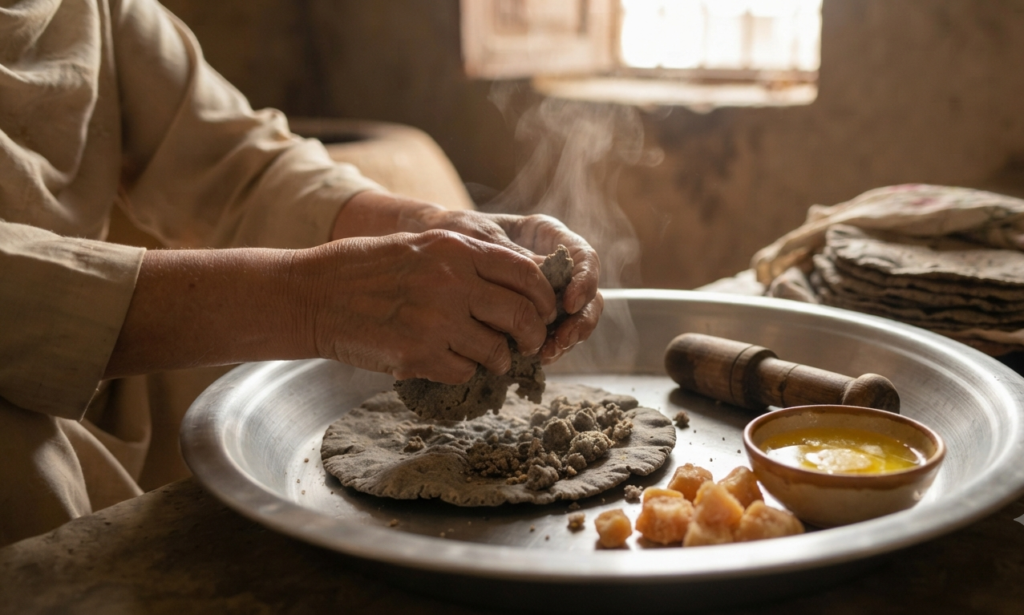
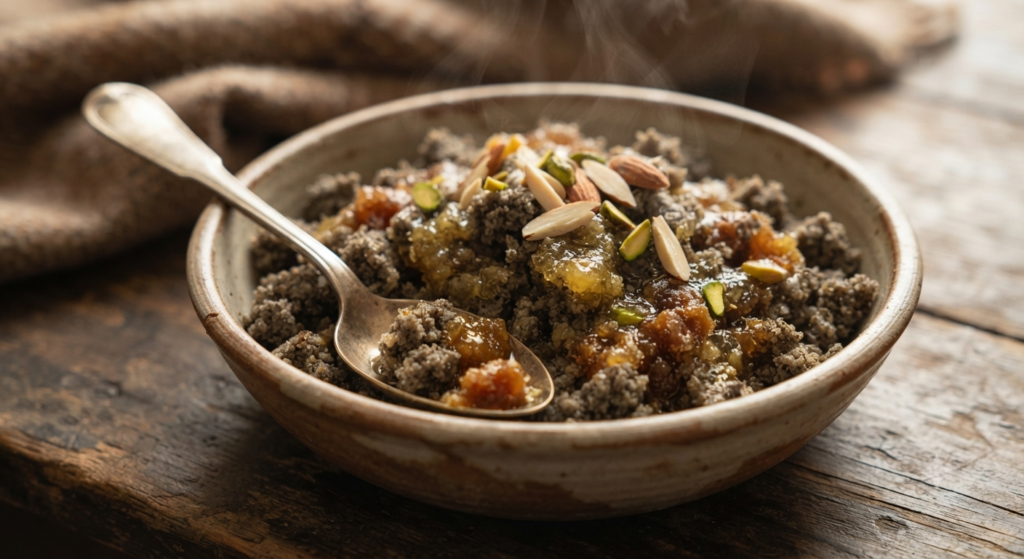
However, my father’s favorite part is not just eating the roti as it is, but having a delicious “choori” made from it. As soon as the roti is hot, small pieces are torn from it, and pure desi ghee and sugar (or jaggery) are added and thoroughly massaged into it until it becomes a soft, sweet choori. My father eats this choori with great fondness and peace, and seeing him makes it feel like this is the true, beautiful identity of winter—warm food, the company of loved ones, and the fragrance of age-old, simple traditions.
The Making of Choori (Process Shot)
This image illustrates the moment the story talks about—crumbling the hot roti. You can see the dark grey, freshly baked Bajray ki roti being broken into small pieces in a traditional steel parat (large plate). Next to it are small bowls of golden desi ghee and chunky jaggery, ready to be mixed in by hand.
Definition of Pearl Millet Flour
Pearl millet flour—commonly known as bajra flour—is a nutrient-dense powder made by grinding the grains of pearl millet (Pennisetum glaucum), a robust cereal crop widely cultivated in dry and semi-arid regions like Africa and the Indian subcontinent. It has a slightly nutty flavor and is frequently used to make traditional flatbreads like rotis or bhakris.
Is Pearl Millet Flour Gluten-Free?
-
Yes, pearl millet flour is naturally gluten-free. This makes it an excellent, anti-allergic alternative for individuals with celiac disease, wheat sensitivities, or gluten intolerances.
Calories in One Cup of Pearl Millet Flour
-
One cup of pearl millet flour (approx. 119 grams) contains approximately 455 calories.
Healthy Vitamins and Minerals in Pearl Millet Flour
Pearl millet flour is packed with essential micronutrients:
-
Vitamins: It contains several B-complex vitamins, including Thiamine (B1), Riboflavin (B2), Niacin (B3), Vitamin B6, and Folate (B9), which help support energy metabolism and nervous system function. It also contains Vitamin E and Vitamin K.
-
Minerals: It is exceptionally rich in Iron (helpful for preventing anemia), Magnesium (supports blood pressure regulation and heart health), Phosphorus and Calcium (vital for bone development), Zinc (boosts immunity), and Potassium.

