I grew up in Sukkur, and for me winter has a smell: hot oil, roasted zeera and beh ke pakoray frying at the little stalls in the evening. Every winter I would sit on one of those red plastic chairs, a plate of hot pakoray in my hand, watching the stall owner wrap each slice of beh in dough as quickly as if he were folding a letter.
When I first tried to make them at home, I was disappointed. My beh stayed hard and chewy inside, nothing like the soft slices I loved at the stall. After a few tries, I changed one thing: I started boiling the beh in water mixed with milk. That small change made all the difference. The beh turned soft and mild, and inside the crispy dough it tasted exactly the way I remembered.
This is the recipe I have been making every winter since, tested in my own kitchen many times, with all the little lessons I learned along the way.
Beh ke Pakoray: A Sindhi Street-Food Favourite
If you have ever walked through a food street in Sindh in winter, you know the smell of beh ke pakoray frying in a big karahi. Beh (lotus root), also called kamal kakri, is one of the most loved winter vegetables in Sindh, and these crispy rolls are a street-food favourite.
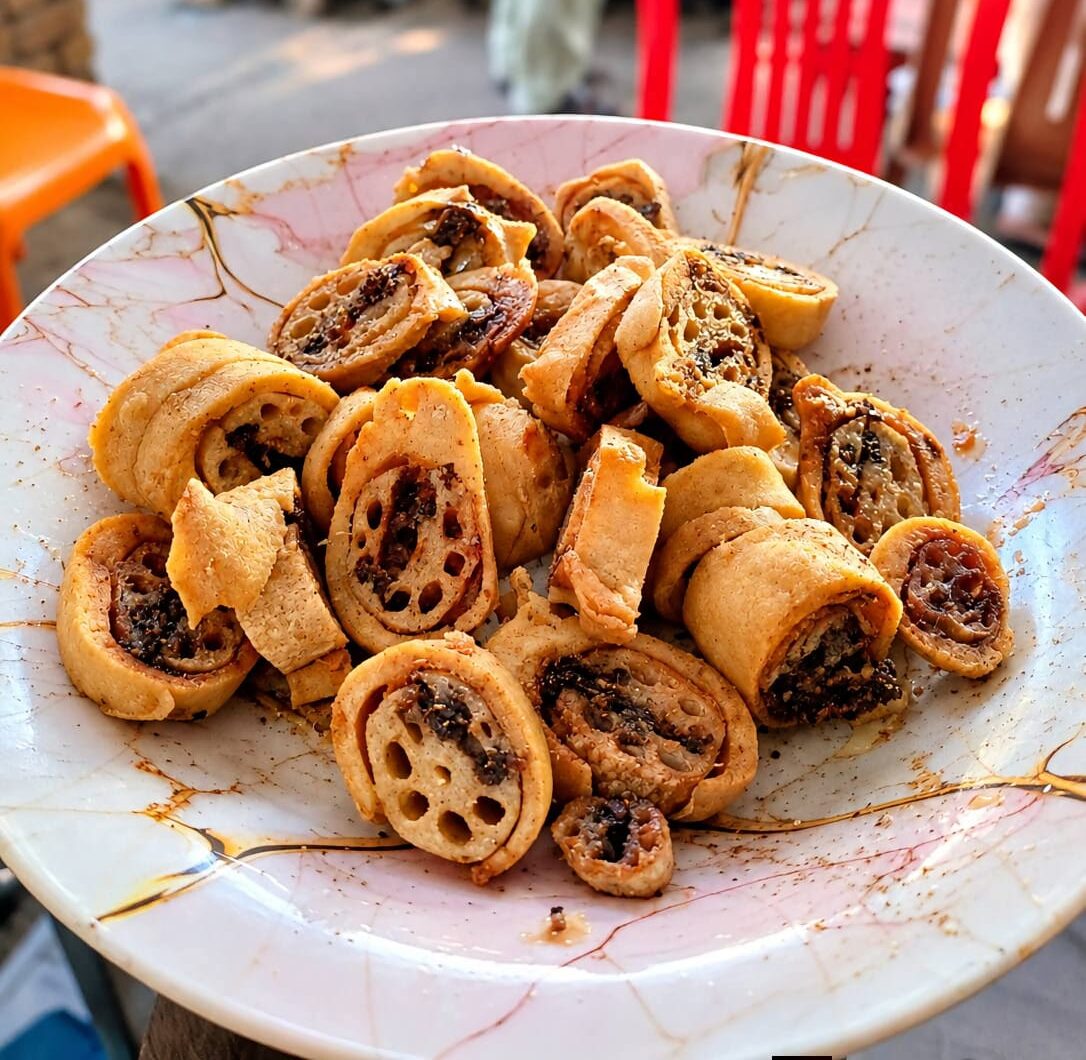
The photo was taken at one of those little roadside stalls, with red plastic chairs and the karahi bubbling in the background. Golden, crispy dough wrapped around soft slices of beh, with that dark, spicy masala tucked into every hole. One plate is never enough!
What Is Beh?
Beh is the root (stem) of the lotus plant. When you slice it, you see a beautiful pattern of holes, like a flower. It has a mild taste and a lovely crunch that stays even after cooking. In Sindhi homes it is cooked as beh ki sabzi, with meat, in biryani, and of course as crispy pakoray.
Why You Will Love Beh ke Pakoray
- Crunchy outside, soft inside: thin crispy dough around melt-in-the-mouth lotus root boiled in milk.
- Bold street-style masala: roasted zeera, dhania, anardana and red chilli.
- Beautiful to serve: the flower-like holes look amazing on the plate.
- Perfect winter snack: with tea, chutney or as a starter.
My Tips for Crispy Beh ke Pakoray
- Clean the holes well. Rinse the slices under running water to remove any mud.
- Boil the beh in water mixed with milk. This is my secret: it makes the beh very soft and gives it a rich, delicious taste inside the pakoray.
- Dry the slices well after boiling so the masala sticks.
- Let the masala go into the holes while tossing; that is where all the flavour hides.
- Roll the dough thin so it turns crisp, not chewy.
- Fry on medium heat and in small batches.
What to Serve with Beh ke Pakoray
Serve them hot with green chutney, imli chutney and a cup of chai. If you love fried snacks, try my crispy aloo pakora, besan pakora and aloo ke kabab. For more Sindhi recipes, see my Sindhi sai bhaji and Sindhi biryani.
Beh ke Pakoray (Crispy Lotus Root Rolls)
Ingredients
Equipment
Method
- Wash the lotus root well, peel it and cut into round slices about 1 cm thick. Rinse the slices to remove any mud from the holes.
- Mix the water and milk in a pot, add the salt and bring to a boil. Add the beh slices and cook on medium heat for 15-20 minutes until they are very soft and tender.
- Drain the slices and let them dry completely on a towel before adding the masala.
- Heat 2 tbsp oil in a pan, add the ginger garlic paste and fry for 30 seconds.
- Add all the masalas and salt, then the beh slices. Toss on low heat for 3-4 minutes so the dark masala sticks to the slices and goes into the holes. Add the lemon juice and let it cool.
- Mix the maida, besan, ajwain, salt and 2 tbsp oil, then add water little by little to make a firm, smooth dough. Rest it for 15 minutes.
- Roll the dough very thin and cut it into long strips about 3 cm wide.
- Wrap one strip around the edge of each masala beh slice (or lay 2-3 slices on a strip and roll it up), pressing the end with a little water to seal.
- Heat the oil on medium heat and fry the rolls in batches for 5-6 minutes, turning, until the dough is golden and crisp.
- Drain on paper towels, sprinkle with chaat masala and serve hot with green chutney or imli chutney.
Notes
Frequently Asked Questions
What is beh called in English?
Beh is called lotus root or lotus stem in English. In Urdu and Hindi it is also known as kamal kakri or bhein.
How do I clean lotus root?
Wash it well, peel the skin, cut into slices and rinse each slice under running water so no mud is left inside the holes.
Why boil beh in milk?
Yes. I boil it for 15-20 minutes in water mixed with milk. The milk makes the beh very soft and tasty, and it cooks evenly while the outside gets crisp.
Can I make beh pakoray without the dough?
Yes. Dip the masala-coated slices in a thick besan batter and fry them like regular pakoray.
When is beh in season?
In Pakistan, fresh beh is easiest to find in the winter months, roughly from November to February.
Have you tried beh ke pakoray at a street stall? Tell me in the comments which city makes the best ones!