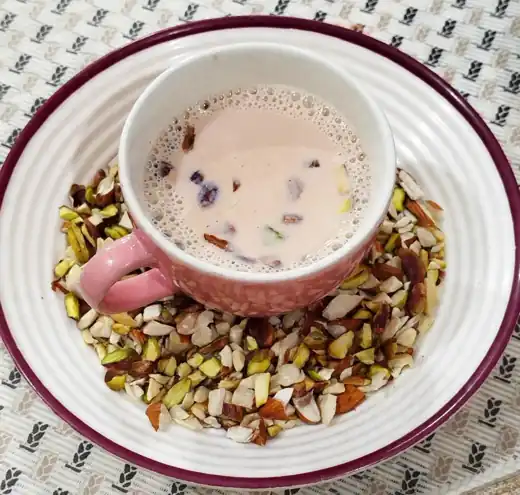
There is something about a cup of pink tea on a cold evening. The colour, the creamy froth and the crunch of nuts on top make it feel like a special occasion, even on an ordinary day. In our house, when winter starts and guests come over, pink tea is the chai I love to serve.
My first few attempts were not pink at all; they came out brown, just like regular doodh patti. Then I learned the real secret: it is not food colour. The pink comes from Kashmiri green tea leaves, a pinch of baking soda, ice-cold water and lots of aerating. Once I understood that, my chai turned that beautiful soft pink every single time.
In the picture I served it with a whole plate of chopped almonds and pistachios, so everyone could add as much as they liked.
What Makes Pink Tea Pink?
- Kashmiri chai patti: special green tea leaves, not regular black tea.
- Baking soda: reacts with the tea and turns the kehwa a deep maroon.
- Ice-cold water: the sudden temperature change helps lock in the colour.
- Aerating: lifting and pouring the tea from a height adds air, which turns the colour lighter and pinker once milk goes in.
My Tips for Perfect Pink Tea
- Use only a pinch of baking soda. Too much gives a soapy taste.
- Don’t skip the cold water. Add it in two parts and boil again each time.
- Aerate patiently. 4–5 minutes of ladling makes all the difference to the colour and froth.
- Reduce the kehwa well. You need about 1 cup of thick, burgundy kehwa before adding milk.
- Use full-fat milk for a rich, creamy chai.
- Salt is traditional. A small pinch balances the sweetness; add more if you like the classic namkeen taste.
What to Serve with Pink Tea
Pink tea goes beautifully with sweet and savoury tea-time snacks. Try it with my crispy aloo pakora or chocolate brownie sandwiches.
If you love warm drinks, you may also like my ginger lemon qehwa and qehwa for cough and sore throat. Planning a winter dawat? My dawat planning guide will help you work out quantities.
Pink Tea (Kashmiri Chai)
Ingredients
Method
- In a deep pan, add 3 cups water, Kashmiri chai patti, cardamom and cinnamon. Boil on medium heat for about 10 minutes until the water reduces to half and turns deep red.
- Add the baking soda. The tea will foam up and turn a dark maroon colour. Let it boil for 2–3 minutes.
- Add 1 cup of ice-cold water and bring it back to a boil. Now aerate the tea: lift it up with a ladle and pour it back from a height again and again for 4–5 minutes.
- Add the second cup of ice-cold water and repeat the boiling and aerating. Keep cooking until about 1 cup of thick, burgundy kehwa is left.
- Pour in the milk and add the salt. Bring it to a boil and keep aerating with the ladle; the colour will turn a soft pink and a frothy layer will form on top.
- Add the sugar and simmer for 2–3 minutes.
- Strain into cups and top with chopped almonds, pistachios and raisins. Serve hot.
Notes
Pink Tea FAQs
Why is my pink tea not turning pink?
Usually it is the wrong tea leaves, too little aerating, or skipping the ice-cold water. Use Kashmiri green tea leaves, add the cold water in two parts and aerate well before adding milk.
Can I use regular tea leaves?
No. Black tea leaves will give a brown doodh patti colour. Pink tea needs Kashmiri chai patti (green tea leaves).
Is pink tea sweet or salty?
Traditional Kashmiri noon chai is salty. In Pakistan, pink tea is usually served sweet with just a pinch of salt. Adjust to your taste.
Can I make the kehwa ahead?
Yes. Keep the reduced kehwa in a jar in the fridge for 3–4 days. Heat 2–3 tablespoons with milk and sugar whenever you want a cup.
What is pink tea called in Kashmir?
It is known as noon chai or sheer chai in Kashmir, and as gulabi chai or Kashmiri chai in Pakistan.